Tuesday, October 27, 2015

Quiche and Crust

Quiches are easy and I make them often. Every time I serve a quiche to friends, they just as often compliment the texture of the crust as they do the taste of the quiche itself. Here's the recipe for the crust, and instructions for how to make any quiche from there.


Quiche Crust (25 minute prep time, 50 minute oven time)
Ingredients
+ 1.25 cups flour
+ 1/2 tsp salt
+ 3 tbps water
+ 1 egg
+ most of a stick of butter (6 tbps)
Preparation
Preheat oven 400 degrees.  
Cut cold butter into the flour. I do this by hand, by cutting the stick of butter into a bunch of medium pieces, and squishing it into the flour until the entire mixture feels like kinetic clay, and looks like this:

By adding the butter to the flour before any liquid ingredients, you're preventing the gluten from polymerizing and forming a tough mesh. This way you get a delicious crumbly crust. Next add the rest of the ingredients, mix until incorporated and knead until homogenous. 
Use a rolling pin to flatten dough on a floured surface. If its too sticky, throw the dough into the fridge to make it firm up. Once its flattened, throw it on your quiche pan -- don't worry about it sticking -- there's so much butter that it's never an issue. Also this recipe makes a little too much dough for a typical quiche pan -- so don't worry about having extra at the end.
There are almost no rules about what to do next -- just whisk together ~1.5 cups light cream and 3-4 eggs together for the quiche guts, and add whatever other ingredients you desire! Cooking those ingredients on a pan beforehand is a good idea (like caramelized onions, softened zucchini squash, or bacon bits). Don't forget salt.
After 30 minutes in the oven, you can use the "jiggle test" (© my mom) , whereby you turn on the oven light and slap the oven door while watching the quiche. If you see ripples travel the surface like a rock thrown in a pond, then its not ready. 

Sunday, May 4, 2014

Raspberry Mousse

I'm actually very bad at baking. Last month, I set my oven 100F too hot while making chocolate souffle (more like carbon biscuits). While I work on that recipe, I thought I would try my hand at a cool raspberry mousse. The recipes I found were fairly similar to traditional tiramisu recipes. Best of all, it's pretty hard to burn, since there's no cooking involved. The following recipe is a combination of this and this, without the hassle of single-serving wax paper fanciness.

Pro tip: don't mix too much at the end to have some pretty anisotropy.

Raspberry Mousse (6 dessert servings, ~1 hour prep time)
Ingredients
+ 4 eggs (separated)
+ 3/4 cup sugar
+ 2 lemons
+ 1 packet gelatin
+ ~300 grams raspberries (one of the small plastic boxes)
+ 1 cup whipping cream
Preparation
Take your serving dish (glass is best) and rub butter along the inside. I had to use two 9' pyrex pie dishes. You could also use glass cups for individual servings.
Juice and filter your raspberries. Add the juice of two lemons. Seeds in souffle can be gross. 
Using an electric mixer, whisk egg yolks with sugar until you have thick ribbons. 
Dissolve gelatin in warm water using a hand whisk. It will look like boogers at first, but eventually it will be almost clear, semithick liquid. The smell reminds me of bacterial Lysogeny broth. Anyway, whatever it reminds you of, fold the gelatine and the juice into the egg yolk mixture. 

With the electric mixer, whip the cream until soft peaks, and fold it in with the gelatin/egg yolk/juice mixture. 
Finally, whisk the egg whites until you have stiff peaks. Fold it in with the rest. I recommend not folding too thoroughly, so that you can see some of the layers of egg white and raspberry pink. Pour it into your dishes.  If you have any remaining raspberry juice, you can drop it on top for decoration. Throw the dishes into the fridge for a couple of hours for the gelatin to set, and serve with fresh raspberries (although that's not necessary). Keep for a couple of days.

Monday, October 21, 2013

A review of the Milk Pail

Do you live in the west bay, near Mountain View? Does your work take you by Palo Alto or San Jose? Then I want to tell you about my favorite all-time market: The Milk Pail. This wont be an authoritative source on its history or business, but rather why it's so much better than the surrounding competition (and why you should care).

The Milk Pail is a small, non-franchise market between Mountain View and Palo Alto. They advertise themselves as a European Market. What does that mean exactly? What do they even sell?

1. Unwholly foods. Citing itself as a European Market is a PC way of saying that the Milk Pail is not stuck up its own ass, like so many yuppy independent markets in the area. You wont find the typical foodie brand that other franchised outlets stuff down your throat. You wont find any health supplements, whether or not it's been approved by the FDA. Don't bother looking for the specific brand of Soy Milk that doesn't leave weird residue taste. The Milk Pail sells unadulterated sustenance: cheese, fruit, veggies, bread, bulk grains, dairy, eggs and a limited selection of meats. If you can't cook from scratch, then move on.

2. What you smell is what you see. I once heard French supermarkets described as superior over those in America because each aisle in France broadcasts a different and wonderful aroma. In contrast, food in the states is shrink wrapped, sterilized and plasticized before its even delivered. The Milk Pail is more like the former: it's messy; the floor resembles the ground at a farmers market, growing denser with food stains as the day wears on. You will not find a perfect pyramid of red delicious apples anywhere, or uniform spreads of pre-cut deli meat. Instead, all the produce is displayed with all the variety of Nature: different shapes and color, sometimes bruised, sitting in the distributor's cardboard box in which it was delivered. Are you a germaphobe? Do you cringe at slightly brown bananas? Is occasional imperfection unacceptable? If so, move on.

3. Cheese, Gromit! As the name suggests, the Milk Pail is an excellent source of cheese. They have an entire room dedicated to cheese, organized by its country of origin. Most of the cheese is not name brand -- the store buys it in bulk and repackages it, selling each cheese in packaged chunks priced by the pound. If you don't know what kind of cheese you like, they have a rotating sample station with 3-5 different cheeses. They also sell fresh bread, delivered twice daily. The best part of it all is the price.

4. The price is right. I am sick of friends telling me how affordable the cheese at Trader Joe's is. It's not cheap. It's just as expensive as Safeway, and by god if you buy produce there, I am judging you. If you want affordable, amazing produce and cheese, the Milk Pail is your friend. The cheese at the Milk Pail is often upwards of 50% cheaper than chain stores. Often, the best cheeses are also on special, and -- bless the Milk Pail's heart -- all the Special items in one location. There are some expensive items in the Milk Pail, like specialty imported goods (which you can specifically request on their website). However, most items are cheaper than any farmers market or store around the area.

Its not a one-stop shop. I don't get everything at the Milk Pail. It's a tiny store, and they couldn't possibly fit more selection in without sacrificing the quality of what they already have. The Milk Pail is not for household supplies, meat or booze. Still, it's amazing the variety of items you can find in the small space that would never be found in Safeway or Trader Joe's.

At least give it a try. Just avoid rush hour -- it can get pretty packed in there. When you're at the register, tell them Alexandre sent you. They'll look at your weird and ask you "Who's Alexandre?"

Please do share your opinion below...

Monday, April 1, 2013

Traditional Biscotti: subsidize your coffee addiction


"A mathematician is a machine for turning coffee into theorems."
A oft-misattributed quote from Paul Erdos in fact invented by the coffee-addicted Hungarian mathematician Alfréd Rényi. Yes, most of us students are addicted to coffee too. In fact, this morning I woke up an hour later than usual and already had a caffeine withdrawal headache (read: definitely not a hangover.)

I may be bad, but I think my coffee intake is pretty average... I buy one or two coffees every day (I go to a drip coffee bar Beckman Bistro at Stanford SoM). That's like $2.50 every day. If I work 200 days a year (lets face it, that's a reasonable estimate), we're looking at half a grand a year. That is a lot of money that I could be putting into retirement (oh yeah -- check out this awesome retirement guide for graduate students by Brandon Curtis here). I think I can understand why coffee is expensive, between farmers, roasters, distributors and baristas). Pastries, on the other hand, are way too expensive.

Lets start with biscotti. Coffee shops sell them individually wrapped for a couple of bucks. For a dry cookie with six ingredients, that seems really really unreasonable, especially for a grad student budget. Biscotti are extremely easy to make, and last forever.

Fun facts: Wikipedia claims the cookie's name is derived from Latin and refers to their "twice baked" recipe. My Italian colleague Carolina Tropini reminds me that if you want to impress your PI, remember to offer them either a single biscotto, or a few biscotti. Here's a recipe I adapted and simplified (from here). I really like it because it makes consistently good crunchy biscotti. Also, they end up being ~10 cents each.


Almond Biscotti (30 slices)
Ingredients
+ 2 cups flour
+ 1 cup sugar
+ 1 teaspoon baking powder
+ 1/8 teaspoon salt
+ Pack of raw unsalted almonds
+ 3 large eggs
+ Splash of Amaretto 
Preparation
Preheat oven to 300F. Don't bother with parchment, these cookies don't stick. 
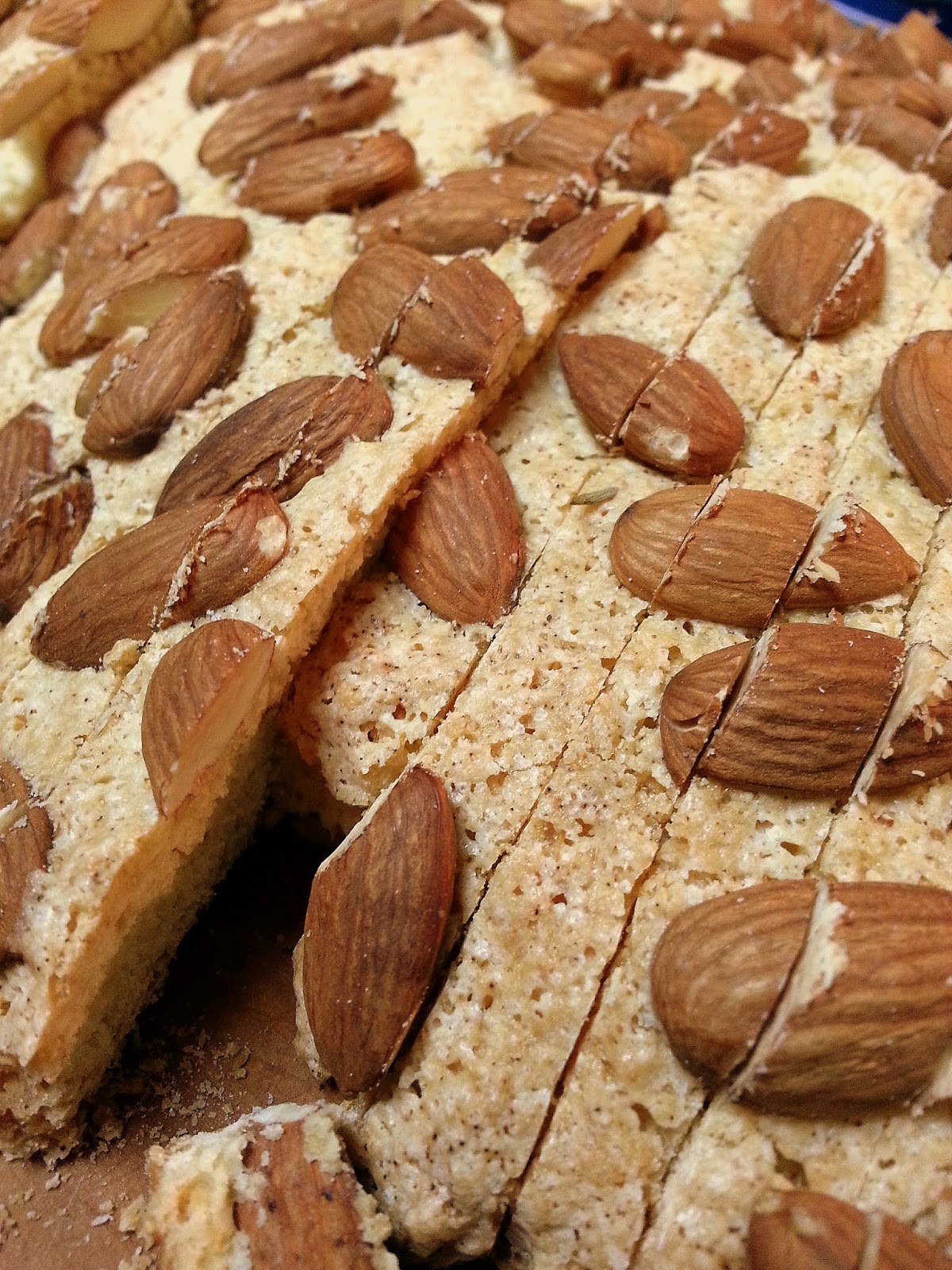
Mix all the ingredients except almonds together until just combined. It'll be a really wet dough. Don't worry about it. Shape it into a loaf thing like in the photo above and cover the entire surface area with almonds (they'll spread out as the dough rises). Bake it for about 45 minutes, or until a toothpick comes out clean after sticking it into the dough. 

Now remove it from the oven, and let it cool down for 10 minutes. Then unstick the loaf and slice it into fairly thin diagonal cookies. Once that's all done, lay them flat back on the same cookie sheet and cook at 320F until browned. The cookies will harden as they cool down, so don't use their consistency as an indicator of "done-ness". Make yourself some coffee and enjoy!


Saturday, December 1, 2012

Tiramisu: Separation of Variables

In lab, I study the morphology of rod-shaped bacteria, such as Escherichia coli, Vibrio cholera, Salmonella, and other fun bugs. I try hard to not bring work home with me, especially when I'm preparing raw dishes. When the dish calls for uncooked eggs, I'll go out of my way to buy caged-free. Laying hen cage confinement can increase Salmonella risk between five and twenty times*. If I'm a food snob, it's for selfish reasons‡.

My father makes a killer Tiramisu, but his recipe breaks a cardinal sin of cooking: he doesn't separate the eggs before whisking! When you whisk egg whites, you're actually denaturing proteins, which aggregate and form the stiff foam. For egg yolks, which are a lot fattier, whisking will instead emulsify the lipids (same thing happens in steamed milk). These distinct physical processes are also mutually exclusive. Lipids will prevent aggregation of denatured proteins. For dishes where the whites are cooked separately (such as meringues), egg separation is crucial. Still -- maybe my dad is right -- maybe since Tiramisu calls for the reunification of the egg for the final product, egg separation might be an unnecessary complication!

To test this hypothesis, I have to go against my word and bring research to my kitchen. I prepared two nearly identical Tiramisu dishes, with the only difference being the separation of eggs.

Parallel Tiramisu being prepared! Right: unseparated eggs; Left: separated eggs.

The result? Well, to zeroth order, I think the results are very similar in taste and appearance. There are two noteworthy distinctions: (1) It took way longer to whisk the combined eggs than the separated eggs. Easily three times longer. My arms are tired. If you have an electric mixer, then this isn't an issue. (2) The texture of the 'separated egg' Tiramisu is slightly thicker.

Parallel Tiramisu being prepared! Right: egg whites, egg yolks, combined egg whisked. Left: Separated egg whisking lead to a slightly grainier, thicker end result.


Although we can skip a step by whisking the egg whole, it actually makes the recipe preparation significantly longer without an electric mixer. Well, here's the recipe in its separated form. Combine the first two sentences if you do not want to separate eggs.
Tiramisu (6 dessert servings, ~1 hour prep time)
Ingredients
+ 4 eggs
+ ~400g Mascarpone
+ 7 Tbs sugar
+ 2 cups strong coffee, room temperature
+ One pack of Lady Fingers
+ Cocoa powder and Marsala wine (optional)
Preparation
Whisk† your egg whites until you have stiff peaks. Whisk your egg yolks with the sugar until you have ribbons. Gently fold the Mascarpone into the egg yolks, and then fold in the egg whites.  
Add 2oz Marsala to your room-temperature coffee. Make a layer of lady-fingers in your serving dish by very briefly submerging each cookie and placing it as depicted in the first image above. Add a layer of the whipped concoction. Add another layer of coffee-soaked cookies, and finish with a final layer of the egg mixture.  
Cover and refrigerate until ready to serve. Right before serving, sprinkle some cocoa powder on top. Enjoy!

(will update with a photo of served Tiramisu)

* Fun fact: the color of eggs is only a function of the hen variety. Hens with brown ears will lay brown eggs. Hens with white ears will lay white eggs.
‡ Fun fact number two: Hens have earlobes!
† Whisking is easier with fresh eggs.

Thursday, November 22, 2012

What to cook for your PI: Tomates Farcies Two Ways

You are more likely to cook for colleagues in academia than in industry. Between your living wage and basic nutrition requirements, cooking can be the most practical gift a graduate student can offer. Follow these cooking tips to make a good impression on your PI:
  1. Always use fresh ingredients and a recipe that calls for thorough cooking. Even if your PI is a microbiologist, she wont appreciate food poisoning. Leave your leftovers in the free-food area at work.
  2. Make sure the dish isn't notoriously time consuming. No amount of hand-prepared fresh pasta using whole-wheat that you spent the last two years growing will impress a PI who gets a whiff of how much time you took off research to make it.
  3. Choose a dish that pairs well with graduation. Hey... couldn't hurt.
  4. Avoid store-bought prepared foods. Your PI is high class, even if he wears jeans with holes and sometimes sleeps on his office couch. Any dish that 'looks' home made is more respectable than guac and chips. Wine is an exception to this rule, and Two-Buck Chuck is an exception to that exception.
I'm joining my PI and his family for Thanksgiving later today, and I'm bringing a couple of Crustic Baguettes and Tomates Farcies Two Ways - a French stuffed tomato recipe. Before sharing the recipe below, here are some possible Autumn dishes that would also work well*:  Hasselback Potatoes (or anything with taters), Bread Pudding, Beet salad, or a nice bottle of Malbec.


Tomates Farcies Two Ways (12 servings, ~1 hour prep/cook time)

Ingredients
+ 12 Tomatoes (not too ripe)
+ 6 garlic cloves
+ 2 yellow onions
+ Parsley
+ Butter, Salt & Pepper
+ Splash of White Wine or Vermouth
+ Parmegiano Reggiano
Farce Type I (traditional)
+ Ground Beef
+ Bread crumbs
Farce Type II (vegetarian)
+ 1 Leek (chopped, dark green discarded)
+ 2 Bell Peppers (seeded, chopped)
+ Mushrooms, one basket
+ Dried Italian Herbs

Preparation
Wash your tomatoes (see above note about food poisoning). Cut the top off each tomato carefully; they will be the tomatoes' hats! Again, carefully remove the seeds using a spoon, but do not remove the meet on the tomato wall. Sweat the tomatoes by salting their insides and turning them over while preparing the next paragraph. Also, start preheating the oven to 460F, 260C.
For either Farce, start by blooming the onions in melted butter over a pot (with high walls, since we're adding lots of ingredients). Once translucent, add the seeds and let the juice evaporate, then add the garlic and parsley. Promptly start adding the ingredients in the order they are listed under each type of farce, waiting a couple minutes between each ingredient.  
Once the meat is cooked, or the veggies are softened, carefully stuff the tomatoes with the farce, adding enough to overflow slightly. Top them off with some Parmesan, add the hats, and throw them in a casserole dish, and throw that in the oven for twenty minutes. If possible, try to use a good looking casserole dish -- these tomatoes do NOT like being moved more than once. Enjoy.


*No, these are not all links to this blog. Sheesh.

Tuesday, October 16, 2012

Baguette Variations of the No Knead Bread: "Crustic Baguette"


Awhile ago I posted the link to the New York Time's no knead loaf. I've made this recipe dozens of times, and I still love it, but I think at this point my version has strayed significantly enough from the original that I can justify posting it here. Let's call it "Crustic Baguette" for now.

What are the main changes? I'm impatient, so I've removed the second rising time completely. Also, instead of making a rustic loaf using a dutch oven (which most of my friends do not have), the recipe now makes baguettes on a cookie sheet. Its faster and easier.

It's easy and a very forgiving recipe. Don't be discouraged if things get messy -- it will still taste delicious. Just don't forget the salt.

No Knead Baguette (makes two baguettes)
Ingredients
+ 3 cups all purpose unbleached flour
+ ¼ teaspoon yeast
+ 1¼ teaspoon salt*
+ 1 ¾ cups water
Preparation 
   The night before, dissolve the yeast in the water, and mix in the rest of the ingredients together in a bowl with a spoon until everything is incorporated. Then cover the bowl with a towel or plastic wrap, and leave it overnight.
   The next morning (at least eight hours later), it will have at least doubled in size and the surface will be dotted with bubbles. Using heavily floured surface and hands, get the dough out of the bowl and rip it in half. The surface of the dough should have enough flour not to be sticky, but try not to incorporate flour into the bread. As the name indicates, you should not knead the dough. Instead delicately shape each half into a long rod. I do this by gently squeezing, not pulling. Plop them on a cookie sheet (don't worry, doesn't need to be nonstick). The loaves will look kinda flat, but they'll rise in the oven.
   Preheat the stove to 450. Fill a loaf/cake pan or dutch over with water and put it on the bottom rack of the stove. By the time the oven is preheated, the water will be boiling, imitating the moist condition of professional baking ovens. Once the oven is preheated, score the baguettes with a knife, and throw them on the second rack of the oven. Bake for ~20-30 minutes, or until they look delicious. 
  * DO NOT CUT THE SALT: Literally every time I've made this recipe, I look at the amount of salt required and shake my head and think "No way that's way too much salt. I don't like as much salt as the average person. I'm watching my sodium intake. I can enjoy this bread with less salt. People have too much sodium in their diet, and I'm better than them. I'll just use half as much".  Then, lo and behold, the baguette just tastes of wet cardboard.

Monday, May 21, 2012

Hasselback Potatoes

Graduate school is a lot of work, but I've had the best time of my life since arriving at Stanford last September. I am still cooking tons, but there's been less time to post the recipes. Here's a short one on Hasselback Potatoes. They're basically potato chips glued at the base. It's not hard at all, and it's a crowd pleaser. I recommend using a smaller potato variant other than regular Russet potatoes for two reasons: since there are no garnishes, the potato's intrinsic taste & texture is going to feature prominently. Check out this cool site for potato varietal infographic. Second, other varietals tend to be smaller and hence cook more quickly.
Hasselback Potatoes
Ingredients
+ Potatoes (I used Yukon Gold potatoes, but red potatoes work well too)
+ Salt & Pepper
+ Olive Oil
Preparation
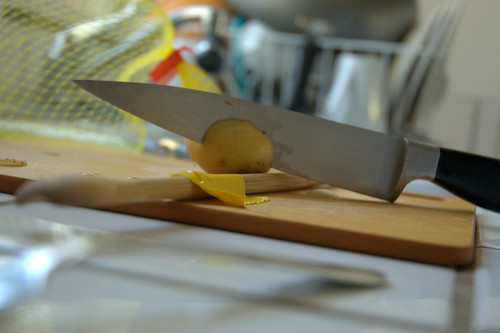
Preheat oven to 400F. Tape a chopstick or thin wooden spoon to a cutting board, as in the photo above. Start slicing the potato in thinly using long knife strokes (slice - don't chop). The chopstick will prevent you from chopping all the way through. 
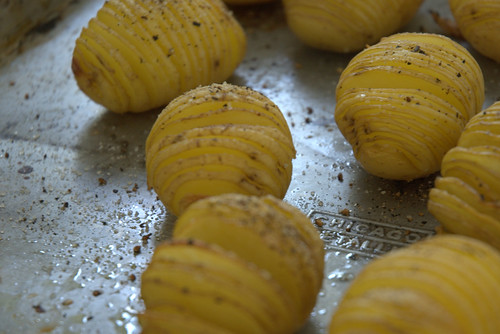
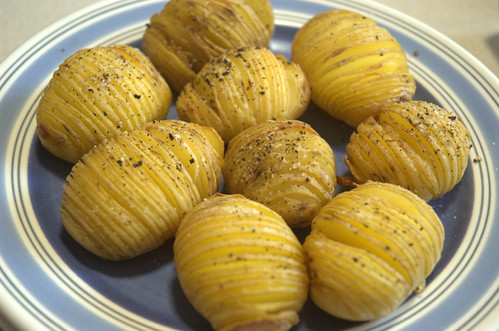
Place potatoes directly on the baking sheet and add a drop of olive oil on top of each potato, along with a healthy amount of salt and pepper. At this point, its normal for the peels to stick together. As it cooks, the peels will separate as in the photos below. Cook them until they start to brown, about one hour (start checking at 45 minutes). 
I did about four small potatoes per person, and served it with a salad. It was plenty of food. 


Monday, July 18, 2011

Graduation and Beet Chips

I apologize for the hiatus from blogging, but I had to briefly graduate. My blog is not for naught, and its loose ends are not yet knotted. I'll still be cooking between class when I start my biophysics PhD at Stanford in another month.

Even though I'm not yet enrolled, here's a neat recipe. I had to use my mom's mandolin (the one she expressly forbade me using). It's nice having an equipped kitchen. Maybe the best part is being able to use two all-clad sauciers!

Anyway, I just came into a lot of beets. We're getting a bit bored of Beet and Potato soup, and these are a nice change - they taste great, and not too beety. Yum.

Beet Chips
Ingredients
+ Beets, peeled/rinsed
+ Salt (optional)
Preparation
Preheat oven to 350F. Slice the beets 1mm thin (I cut them 1 mm thicker, and they turned out a little soft). Do not slice your fingers - blood is difficult to discern from beet juice.
Lay out pieces on any kind of baking tray. Sprinkle salt if desired. Bake for 15-20 minutes, keeping an eye after 15. Remove and let harden/cool. Eat.
Source: Fix Me A Snack
(click for high resolution)

Tuesday, May 31, 2011

Your taste in music.

Here's a quatrain I wrote while coming up with something to write about:

The sound of music, the taste of food
Help find my lyric, help change your mood.
Follow the metric, its not poetic,
but a recipe that serves two.

Now here's a cover by a band called "Cibo Matto". You should listen to it while reading the rest of this post.


Cibo Matto (meaning crazy food in Italian) ... are a New York City-based band formed by two Japanese women, Yuka Honda and Miho Hatori, in 1994. The lyrics in their songs are primarily concerned with food and their sound has been described as a combination of "Jazz, Hip-Hop, Brazilian music, African Drumming, and Disco samples". -Wikipedia June 2011

Do I have any choice about liking this band? Do you?

Now here's a recipe that I am making tonight, credit my dad.
Smoked Salmon Spaghetti
Ingredients
+ One pound spaghetti
+ Heavy Cream
+ Salt, Pepper
+ Shallots
+ One tablespoon butter
+ ~4oz Smokes Salmon, wild like the wind.
Preparation
Cook Pasta.
In another pan, bloom the diced shallots in the butter. Add the heavy cream.
Do not add the salmon.
Add cream mixture to cooked/drained pasta. Now add smoked salmon. Salt/Pepper to taste. Serve.

Sunday, April 24, 2011

Beet Generation


"Ah Sal you are all right.", said Remi Boncoer as Dean and I walked into his house. He patted me on the back, and avoided eye contact with Dean, who looked hurt, but only for a second. His expression was replaced by swaying and longing for the last fifteen dollars we spent at the bar that night.

Lee Ann came around the corner from the kitchen. She saw Dean and halted and sped backwards back into the kitchen. Remi glared a Dean and followed her into the kitchen. They began arguing in whispers, but not quietly so I could hear everything and so could Dean. I looked back at him and his eyes returned to normal. He rubbed his belly and sweat was beading on his sunken cheeks. He paid no attention to the hisses around the corner.

Dean walked over to the set table, talking on the way "My pa made this for me, back in Denver." The idea that his wino father ever cooked anything surprised me. I thought of boyhood Dean kneeling over the trashcan fire in an alley of Larimer street, hiding from the rain under his father's coat. I was so tired and broken, so beat that I couldn't think of anything else.

My eyes must have glazed over because Dean walked towards me and stopped when his face was only a few inches from my face and he yelled with a full mouth, "Try this - you have to!". Remi's French accent was still audible two rooms away now, and I knew I would have time to try some without him noticing. Using two fingers so as to not make a mess I tried one of the red cubes. The taste reminded me of dirt, or earth, but it was also tart, and it was such a beautiful color. It was the first real food I had eaten in two days.

"What is it?" I asked and sneaked another piece, but Dean was already gone. I heard his footsteps walking towards Remi and Lee Ann and his booming voice "Hey Lee Ann! My pa made this all the time! Lee Ann! How do you make it? Lee Ann!"

It took longer than I thought to find the kitchen, since the floor was moving from the booze. I sat down on a chair by the door and must have passed out for a second, since by the time I caught up to Dean and Remi and Lee Ann they were all quiet and leaning on the counter. There was blood on Dean's hands - he was peeling beets and cubing them. Remi saw me walk in but said nothing and turned his gaze back to the cutting board. It wasn't blood as I thought; it was the juice from the beets.

Lee Ann was dictating her recipe: "Not so big, or they wont cook. Okay now just add olive oil and salt and put them in the ov-" but she couldn't finish because Dean had left the room and we heard the front door slam. I had found a chair by now and we had nothing to say to each other, but Remi looked happy staring at Lee Ann.

Dean walked back in with the bottle of Chablis wine from the car that we couldn't bring ourselves to finish and forgot in the trunk. It had been open for months. He uncorked it and the entire kitchen smelled like rotting vinegar and before Lee Ann could protest he poured a little on the Beets. "My pa did this I remember because he said he never wanted to waste the wine, even when it was bad."
I was happy the oven was already on, and Dean opened it and the gust of warm air made me shiver more than anyone else has ever shivered in San Francisco. He singed his arm hairs putting the beets in the very back of the oven - it must have been hundreds of degrees hot. I began feeling feverish and I fell asleep.

The next morning I woke up at noon and I felt alright, and Dean and Lee Ann seemed to be getting along. He made the beets again that night and I tried some again and he was right it tasted delicious and we talked about starting a beet farm. Dean's hands were permanently stained red. At the end of the second day in San Francisco, Remi was concerned that he was getting old and Dean spent two hours talking about how excited he was about life and the things he was going to do.

Later that night Remi caught Dean trying to make with his girl. Lee Ann was not that kind of girl but it didn't matter, Dean's hands were red. I never saw Remi that mad and he told us to leave his house, even though it was Lee Ann's house. I told him I would come back without Dean but it Remi said he didn't want me to. We never unpacked the Buick so we got back in and started driving. The car was really quiet and Dean knew I was angry so he said "Now Sal, Lee Ann was the one who started it. I was trying to get her to stop but you know I miss Denver and anyway we were out of Chablis. There was no reason to stay without those beets." He started rubbing his belly and driving with his knees. We were driving back to Denver.


Wednesday, April 13, 2011

Cook Pasta as Risotto : Asparagus Pastotto

So there's been a recent interest going around about cooking pasta as one would risotto. I first read this advice in this season's Cook's Illustrated, but apparently it was also written in the NYT recently. In both places, it was just a two-sentence snippet with no recipe to back it up. Was this just another far-fetched excuse to add (even more) butter to pasta, or a treasonous disfigurement of Italian culture?

So I took the advice to its fullest meaning - after finding a suitable recipe for Asparagus Risotto (from NYT), I added a sprinkle of Ctrl-f Ctrl-v, I had myself a de-bonafide Pasta-Risotto recipe.

A quick google search confirms that I am not the first to test this recipe, or to coin "Pastotto". Still this recipe came out pretty darn delicious, and I hope you give it a try! I added at least one family secret, and tested the dish's robustness as left-overs.
Making Of: Pasta-Risotto
Asparagus Pastatto
Ingredients
+ One bunch Asparagus (it's in season!), cut into 1-inch pieces
+ Chicken or Vegetable Stock - 4 cups
+ One pound of your favorite pasta - I used Fusilli
+ Splash of white wine - I used Pancake Cellars 'Big Day White'
+ Two tablespoons butter
+ One Onion, diced
+ Salt and Parmigiano-Reggiano to taste
Preparation
Add the stock to a small pot and keep it warm under low heat.
Boil half the asparagus for five minutes in two cups of water. Drain the green water into the warming stock pot. Blend the boiled asparagus with a food processor, blender, or hand blender. Set aside.
Melt half the butter in a large pan with rounded edges and high walls. Once the butter has stopped bubbling, add the onion and let it soften, five minutes. Add the pasta and coat it as evenly as possible with the butter and onion, for two minutes.
Add a splash (half cup or so) of white wine and let it boil away while constantly stirring. Don't forget to pour yourself some wine to drink slowly throughout the cooking process.
Now, start adding about the broth a cup at a time. Also add the other half of the uncooked asparagus, as well as the pureed asparagus. Continue in this fashion until the pasta is cooked - watch out! Pasta takes significantly less time to absorb the water and finish cooking - it took me about an hour.
Finally, once the pasta is tender, add a half cup of grated Parmesan, another tablespoon of butter, and cover the pot. Do not touch the pot for five minutes.
Uncover, mix thoroughly, and serve immediately.
Pastotto Pancakes
As leftovers, you can always panfry your risotto/pastotto with a little butter. The pasta does not hold together as well as risotto traditionally does, but it's still quite tasty.
Here is the finished product. Enjoy!
Pasta-Risotto

Sunday, April 10, 2011

Kumquat Marmalade Recipe

Just around this time last year, I binged on kumquats from the farmer's market. The sweetness of the kumquat rind and acidity of its pulp made my teeth unbearably sensitive for the next week. Just looking at my left-over kumquats made my mouth ache. Instead of throwing them out, I made a really successful marmalade! Unfortunately, the season was over before I could make more.

I've been waiting all year to make the recipe again, and this time I took some photos with which to share the recipe. I've listed the ingredients in terms of how many kumquats are used.


Warning: This recipe should be started the night before...
Kumquat Marmalade
Ingredients
+ Kumquats (as many as you have!)
+ Sugar
+ Water
Preparation
Wash all the fruit and remove any green stems. The photo above shows the kumquats without the stems. Don't worry about removing the seeds in this recipe - they're mostly harmless.
This is the most labor intensive part. Start slicing each kumquat thinly. I usually cut them in half length wise, and mince them like I would some garlic cloves, as in the macro shot below. It takes about 1 hour for me to slice 100 kumquats. I had blisters by the time I was finished.
Now soak the rinds and pulp in three times their volume in water for twelve hours, or over night. The next morning, bring them to a boil until all the rinds are very tender. This takes up to an hour.
Like this! See that film on the top? You're going to want to remove that at this point.
Now it's time to add the sugar! Add the same volume of sugar as you have fruit, and bring it back to a boil. At this point, I start bringing out spoonfuls of the liquid (be careful, it's kind of hot) and putting them in the freezer to bring them to room temperature quickly. Every 15 minutes, check the consistency using this method until the desired spreadability is achieved.
Then fill sterilized (or at least clean) jam jars 90% and close them tightly immediately. As they cool, the warm air in the 10% remaining will cool and form a vacuum inside.
See for yourself:

Friday, April 8, 2011

Career Goals

I have a pretty hands-off upper-division writing professor at UCI. That doesn't stop said professor from assigning menial chores to keep us busy and out of his hair. In particular, last week he decided that we should write up our career goals, and our qualifications for those goals. Here are mine - enjoy!

(click for bigger pdf version)


If this elicits a response from the professor, I'll post an update. To be clear, I've been completely transparent with the professor about my dissatisfaction with his absolute lack of feedback.

I've been pretty terrible about keeping this blog food-centric. I'll post something about food before the end of the weekend. Maybe it'll be my Dad's Marmalade Jam recipe:

Saturday, April 2, 2011

Calories and Growth

We finally got around to planting seeds in the Ants in your Plants garden today. We had a really great crowd! You can check out more photos here.

Now that we're well established, and that we have a regular schedule, there are a few projects I want to complete (...and start) at the garden before the end of the Spring. We need a rodent fence, maybe a live webcam, some picnic tables, composting, and a pizza oven!

But what's interesting is that we worked really hard to plant every thing today! I can hardly believe that humans can maintain a farm and still reap net positive calories from the land. It's especially relevant for me: tomorrow I am biking 200km (124 miles) around orange county tomorrow. On these long bike rides, your body is limited by the rate at which your body can digest calories. In fact - you have to be eating constantly - the average human body can only digest about 300 Calories an hour. Moderate biking is about 500 Calories an hour - see a problem there?

I want to give a shout out to my dad, who I'll be joining tomorrow morning on the tail end of his 600-km bike ride. Yes, it takes more than 24 hours to ride. Yes he sleeps - but not more than a couple of hours. Yes, he has to eat A LOT. Here's the route that I'll be joining him on. Feel free to him positive vibes.

Oh man that's cruel. He'll have finished this route before starting the one up there. No carbon fiber bike can make 600km even remotely easier. Most of the gear that they do have is to help carry food. The wife of the late Sheldon Brown (famous for his online bike articles) rode 1200km with an entire roasted chicken. Classy.

Anyway, as the garden grows, I'll keep posting photos of the seeds as they start sprouting. We planted over 50 varieties in all! That's so many!

Monday, March 28, 2011

No Knead Bread

New York Times no-knead bread, crackling out of the oven, with birds in the background.


You can get the awesome recipe here. This should be in everyone's cooking repertoire, no question. Hopefully this link will continue working even after NYT starts its digital subscriptions. If it doesn't, comment this blog and I'll reproduce it here until they come up with a student subscription plan.
Good start to the quarter...

Addendum: I've added my own version of this recipe. 

Friday, March 11, 2011

Bubble and Squeak

It's just around St. Patrick's day, and cabbage consumption is on the rise. Seeing it around the grocery store made me think of Bubble and Squeak - a cabbage potato recipe with a fantastic name. Actually the name is motivated by the sound the dish makes as it cooks.

It's perfect for the end of Winter. My mom made it for my brother and me all the time as a quick meal. So I made it again tonight. It's surprisingly tasty, for such a simple recipe.
Bubble and Squeak!
Ingredients
+ Potatoes, a few medium ones
+ Cabbage, a large head, or two small ones, chopped up
+ Salt
+ Olive Oil
Preperation
Boil cabbage and potatoes for twenty minutes. Drain, and throw it all on a hot pan with olive oil. Sprinkle a decent amount of salt and let it brown a little, stirring occasionally. You can choose to add sausage or other meat of some sort, but it's pretty good by itself! Pairs well with cold weather and potato famines.

Monday, March 7, 2011

On Food and Bias | Wine, Foie Gras, and skin.

Today in my advanced physics lab, professor Kirkby discussed the importance of unbiased data analysis. In particular, he talked about how scientists can use a chi-squared test as a way to objectively assess the validity of one's error bars. That got me thinking about bias in the food industry.

Just last weekend, I went wine tasting in the Santa Cruz mountains, as part of a visit to Palo Alto. I was surprised by how reasonable the tasting was. Picchetti (above) winery offered 5 1oz tastes for only $5 dollars. The cheapest bottle of table wine was $21, but the price of tasting is refunded if you buy anything.

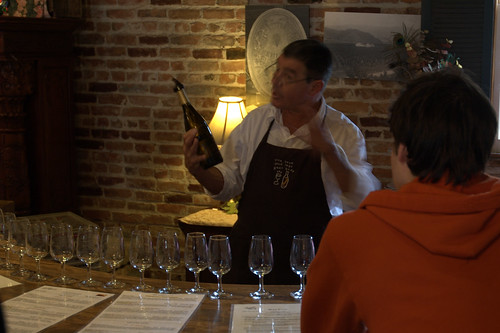
Our host - pictured above, teaching us how to taste wine - described the history of wine in California. In particular, he recounted a 1976 wine competition later known as The Judgement of Paris. It was one of the first blind-wine-tasting competitions in which California wines were invited - before that, France was neck-deep in its own pride to take them seriously (as a French citizen, I can say this). Beyond anyone's expectations, the American wines snagged first place in a significant number of categories. The results and ensuing controversy/embarrassment sparked and fueled the wine industry in California.

Though there is no doubt that Californian wines have merit, it's interesting to note that the results of the competition were disputed for a few years. Sure - these were motivated by nationalist interests, but they were not mathematically unfounded. Specifically, the Judgement of Paris competition only had about 10 judges with no common grading rubric. The resulting scores for each wine had huge deviations among the tasters. In the end, only two of the average wine scores could be identified as statistically significantly successful. In other words, the other wines were statistically indistinguishable (their error bars overlapped).

Since, the controversy has calmed, and the Judgement ultimately improved the quality (and quantity) of wine in both Europe and America. (Cool fact: Forbidden Wine is wine produced in Islamic countries, where alcohol is not religiously allowed. For example, Morroco makes about 40,000 bottles of wine a year. The majority is not exported).

It seems unbelievably appropriate, now, to bring up another French-California food topic that has recently grown in controversy! That's right - Foie Gras - literally "fatty liver" in French - is pureed liver of duck or goose. The fowl are force fed, and animal rights activists recently successfully introduced a law in California banning the production and sale of foie gras. (I wont go into this today, but I think the process is no less cruel that the conditions subjected to all other conventionally raised cattle. Stay tuned for a post about a field trip to witness cattle butchering and gutting.)

Akin to wine tasting, a recent study asked the question: Is it Foie Gras or Dog Food? The study gave 18 people 5 different pureed meats, only one of which was dog food. Only three subjects successfully identified the dog food. The report concludes "People cannot distinguish dog food from pâté intended for human consumption". Hell, what subset of the population eats foie gras (or dog food for that matter) often enough to readily remember its taste?!

I take issue with the study on several levels, but one this is clear from all these above examples: taste is an incredibly liquid, subjective sense. Consider how much smell plays an affect on taste, especially in a small kitchen:
My kitchen is tiny. When I cook something, my nose is inundated with everything we boil and broil. (Above, Ari, Mike and Jake are making a Poor Shepard's Pie). By the time we sit down, the receptors in my nose have been saturated by the ubiquitous smell of my food, which ends up tasting bland as a result.

For a long time, I would step outside for thirty seconds before eating to try and clear my nose. These days, I employ a neat trick I learned from a friend. I don't know how it works:

Smell your skin to reset your nose.

Saturday, March 5, 2011

Ring Road and Radians

Preface: I'm almost embarrassed to post up a math discussion of such a simple problem, but the answer is nonintuitive enough to be interesting. Please share your thoughts!

Today is something a little different: math. I'm sure some of you have already lost your appetite - but hang on for a second. This is sort of interesting.

TL;DR I math'd a graph for Anteaters who don't know whether to take inner or outer ring mall.

As I'm sure many people do, I always wonder if I'm walking to class via the most direct path. It's a matter of efficiency and elegance. It's also a matter of trying to get to class on time.

So in the midst of mentally minimizing my mileage at UC Irvine, I considered the two main paths that make up the campus.
If the above image is not clear, the campus is pretty much a donut (geographically, demographically). (I live right next to the star-trek library on the bottom left). In fact, it's two concentric circles, one slightly smaller than the other. One can more or less travel between the two circles. The idea can pretty much be distilled as in the following image:
Lets say you're at your computer science class on the south west side of campus, and you want to get some Peets coffee on the north of campus. Both points are on the outer circle, but you have full access to the inner circle. You want to get caffeinated as soon as possible, and you ask yourself: should I cut to the inner path (red), or travel on the circumference (orange)?

We can find the conditions for the paths to be equal by setting the last equation to zero. By inspection, we find that at two radians exactly, the paths are equal.

I arrived at this answer the first time I formulated this problem, but it seemed so strange for two reasons. Firstly, the functional is independent of radius. Secondly, my intuition thought that it was strange to find an integer value of radians.

I asked my friends to find my error, and it wasn't until Mitchell Hsing pointed out that math doesn't lie that I reconsidered the validity of this conclusion. Assume for a second that it's correct:
Absurd!! Regardless of the relative or absolute sizes of the circles, the two paths are always equal at an angular distance of two radians. If you know any reason why this should be intuitive, or why it isn't, add a comment!

Anyways, I since made a handy cheat sheet for UCI to help you decide whether you should take the inner or outer path. It's a little simplified, but I hope you enjoy it! You can download the full version here.


Tuesday, March 1, 2011

Bread Pudding Recipe (by popular demand)

Sadly, today marks the first time in two years that Lees - a Vietnamese sandwich shop by UCI, raises its prices by 5¢. The food isn't terribly good, but they make fresh baguettes from scratch, all day. For one dollar, they'll hand you a still-crackling crusty baguette that burns your hands. More importantly, for the same price, you can buy TWO baguettes from the day before.

Woah. I know what you're thinking - you're thinking: "I thought this guy pretended to have standards!" It's true, I do. But I promise that when I buy day old bread, it's for one reason only: bread pudding. There is no easier, cheaper way to fit protein and carbs into a dozen students at a potluck. It's pretty much impossible to mess this up.
I learned that a lot of American's think of it as Southern food, but it turns out people have been sneaking day old bread into desserts to serve to unsuspecting guests for centuries - well, really, ever since the invention of sliced bread! Much more historical details here.

This recipe pairs well with "A Sunny Day in Glasgow".

Bread Pudding Template Recipe
(ie. Be sure to deviate from this recipe)
Ingredients
+ baguette, or other bread, that's too stale to eat
+ a few cups milk
+ a few eggs (1 egg per cup of milk)
+ 1 cup sugar for every 4 cups milk)
+ dash of salt
+ deep casserole dish
Preperation
Preheat Oven to 350F/177C/450K
Slice the bread up into a few pieces, with a few inches of thickness each. Use a hacksaw or axe if it's too stale. Keep the bread in the casserole dish while whisking/mixing together eggs, milk, sugar & salt until combined. It should be a pale yellow color.
You'll have to mess with the amount of the mixture, since it'll depend on your bread density and amount. Generally, I make enough mixture to reach a third of the height of the bread. At that point, I squish the bread into the mixture to help it soak up the liquid. If your bread is too stale, leave it for an hour. Add your dried fruit now too (I like raisins best).
Shove it in the oven for 30 minutes, or until browning on top.
Serving
By itself, or Maple syrup or Ice cream. You can't go wrong.